The noise textures used in this post, and the python scripts used to generate the diagrams, can be found on github at https://github.com/Atrix256/Threshold_STBN_FAST
Thresholding blue noise textures can be a decent way of getting blue noise points at runtime in real-time rendering. They aren’t the highest quality point sets, but they are fast to make and they can use a density map for the threshold value to make non uniform blue noise points, so they are very convenient.
At various times over the past year or so I’ve stumbled on evidence that seemed to show that thresholding FAST noise textures made lower quality blue noise point sets than when thresholding STBN noise textures.
STBN is “Spatiotemporal Blue Noise Masks”, which aims to have N slices of perfectly good blue noise textures, where each pixel individually is also blue over time. We published it in 2022, and it worked well. https://www.ea.com/seed/news/egsr-2022-blue-noise
FAST is “Filter Adapted Spatiotemporal Sampling”, which eclipses STBN by working for arbitrary spatial and temporal filters, while also increasing the quality of noise textures over STBN, particularly of the vector valued noise textures. We published it in 2024 and it was a nice improvement over STBN. https://www.ea.com/seed/news/spatio-temporal-sampling
So, it was a little bit confusing that thresholding FAST noise textures would be lower quality than STBN, when everything else seemed to show that FAST was better or equal to STBN in every single way.
This post is to finally do those threshold tests and share the results. First lets talk about all the noise types involved. Here they are along with their power spectrums (DFT magnitude).
You can click on the images in this post to view them full sized.

Note that all DFTs in this post are divided by the same value to make them be in the 0 to 1 range, so you can compare them to each other.
- FAST S – A 128×128 spatial blue noise texture optimized by the FAST optimizer for a Gaussian low pass filter with a sigma of 1.0.
- FAST ST – The first slice of a 128x128x32 FAST noise texture like FAST S, but optimized over time for a Gaussian filter with a sigma of 1.0 as well, with the filters “separate 0.5” (added) not “product” (multiplied).
- STBN 1.0 S – A 128×128 spatial blue noise texture optimized by the STBN optimizer (a void and cluster variant) with a sigma of 1.0.
- STBN 1.0 ST – The first slice of a 128x128x32 STBN texture also optimized for a gaussian filter over time with sigma 1.0.
- STBN 1.9 S / ST – the same as STBN 1.0, but using a sigma of 1.9 instead.
- VNC 1.0 S / 1.5 / 1.9 – 128×128 spatial blue noise made using the void and cluster algorithm made with sigmas 1.0, 1.5, and 1.9 respectively. The void and cluster paper recommends 1.5 and the “free blue noise textures” site uses 1.9. I’m including 1.0 as another data point.
- Tellusim ST – The first slice of a 128x128x64 spatiotemporal blue noise texture, using a custom algorithm, from https://tellusim.com/improved-blue-noise/. This noise is actually 16 bit greyscale instead of 8 bit, which gives it many more unique values than the others. Up to 65,536 instead of 256.
- Fidussion ST – The first slice of a 64x64x16 spatiotemporal blue noise texture, using a custom algorithm, from https://acko.net/blog/stable-fiddusion/
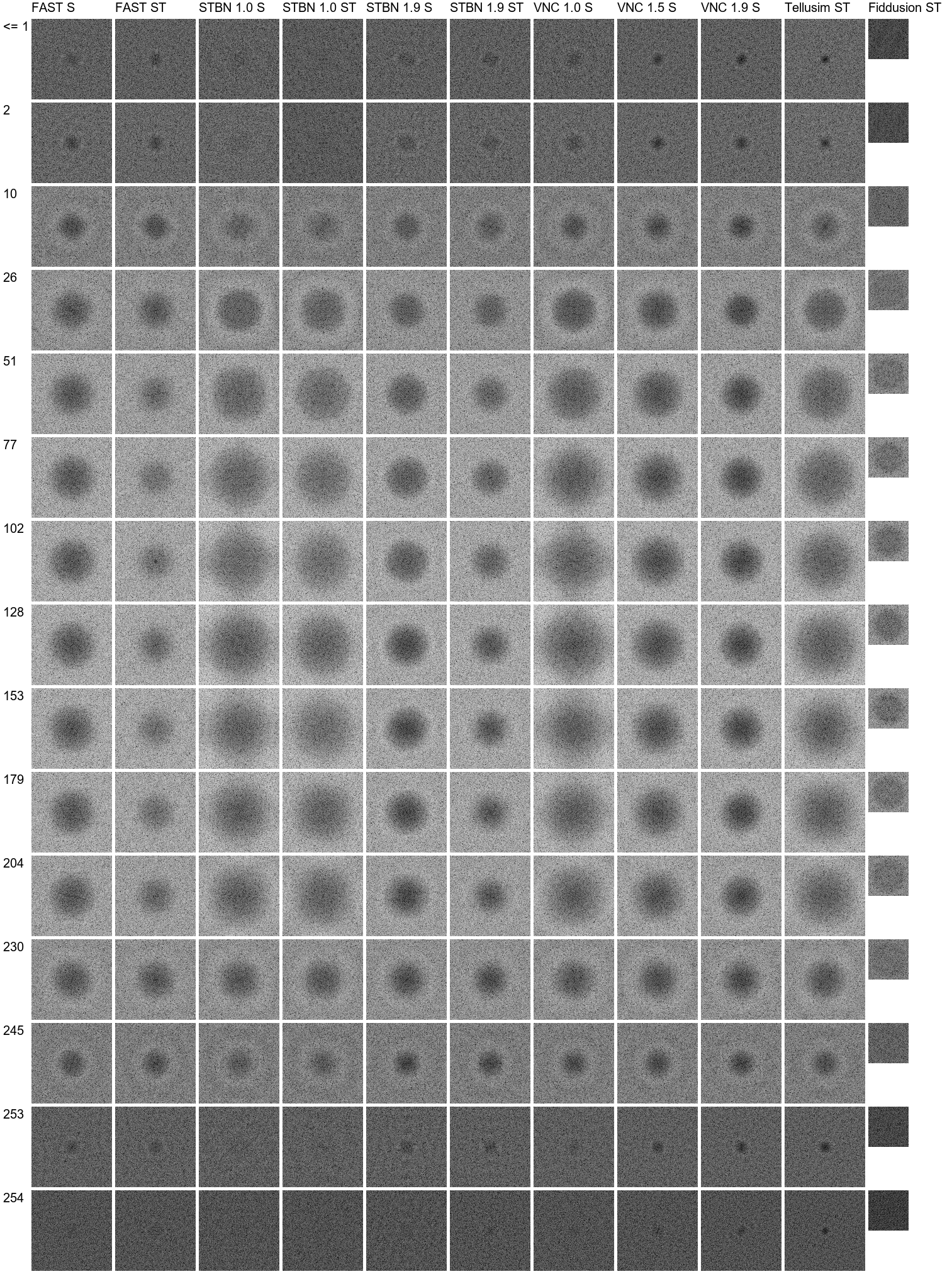
Next up, let’s threshold these noise textures. The first row labeled “<= 1” means “if the pixel value is <= 1, write a black dot, else write a white dot”. The second row labeled “2” means “if the pixel value is <= 2, write a black dot, else write a white dot” and so on.

Here are power spectrums of those thresholded values.
Observations
We should start out by noting that thresholding is just one way to measure the quality of blue noise textures. If you are using a noise texture for stochastic transparency by testing alpha against the noise texture to see if you should discard a pixel or not, thresholding quality matters to your result. If you are dithering, the thresholding quality won’t matter for your result
This is important because in the first diagram that shows the power spectrum of the noise textures, the Fidussion texture shows itself to be very high quality blue noise – it has a very dark center circle showing very little low frequency content, and the circle is about as large as it can be within the square. When you use this noise, it pushes as much of the “rendering error” that it can into the highest frequencies, so that it’s more easily removed with a Gaussian low pass filter, and perhaps is higher perceptual quality as well.
However, when we look at the thresholding tests, Fidussion does the most poorly by far. I believe the noise is able to do better as a whole because it doesn’t try to satisfy the thresholding quality constraints. So, if thresholding quality matters to your usage case, you wouldn’t reach for the Fidussion noise, but otherwise, it might look pretty attractive! Basically “Quality is as quality does”.
Overall, none of the textures seem to do very well when extremely sparse, like when <= 1 or <= 254. That is 0.004 and 0.996 in floating point. They all do pretty ok between 10 and 245 though, which is 0.039 and 0.961 in floating point.
VNC 1.9 and Tellusim seem to do pretty ok at the extreme sparse values. VNC 1.9 is not spatiotemporal noise, but Tellusim is. Tellusim doesn’t show as nice DFT in the middle range though. You can see the circle of suppressed low frequencies is not as dark.
In the end, I don’t really see that STBN is better than FAST when thresholded. I think I saw FAST in the extremely sparse zone and didn’t recall ever seeing STBN in the same situation, so it seemed worse.
One other thing these diagrams show though is that if you add temporal constraints to spatial noise, the spatial properties of the noise seem to suffer. I am not certain, but I think that is probably unavoidable – the more constraints you put on something, you eventually reach a saturation point where the constraints can’t be solved, or can’t be solved as well. It would be great if I’m wrong though!
FAST does let you specify how much weight to give the spatial filter versus the temporal filter when doing “separate” mode like this instead of “product”. It defaults to 0.5 which is a balanced weighting between the two. Maybe playing with that could give better results in some situations.
I’d bet there’s a way to make blue noise (spatiotemporal or spatial only) that solved the thresholding constraint better, maybe at the cost of making the overall DFT of the noise texture worse. If you are only ever going to use the noise for thresholding, you don’t need it to have good qualities for other uses.
Links
My void and cluster implementation: https://github.com/Atrix256/VoidAndCluster.git
“Free Blue Noise Textures”: spatial blue noise textures of various kinds, and a python void and cluster implementation: https://momentsingraphics.de/BlueNoise.html
The original void and cluster paper from 1993: https://cv.ulichney.com/papers/1993-void-cluster.pdf
 The blog at the bottom of the sea